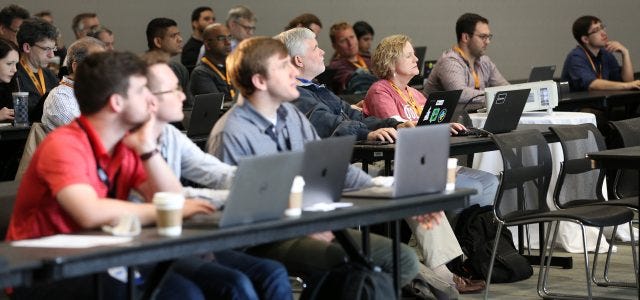
AI and data science are advancing at a lightning-fast pace with new skills and applications popping up left and right. At ODSC East this May 13th to 15th you’ll find hands-on instruction, featuring real-world use cases and practical examples, that will enable you to put your new skills to good use immediately. Check out just a few of the sessions you’ll find at the can’t-miss conference of the year.
Training Sessions
Bayesian Analysis of Survey Data: Practical Modeling with PyMC
Allen Downey, PhD, Principal Data Scientist at PyMC Labs
Alexander Fengler, Postdoctoral Researcher at Brown University
Bayesian methods offer a flexible and powerful approach to regression modeling, and PyMC is the go-to library for Bayesian inference in Python. In this hands-on session, you’ll start with logistic regression and build up to categorical and ordered logistic models, applying them to real-world survey data. Through practical coding exercises, you’ll gain the skills to implement Bayesian regression in PyMC, understand when and why to use these methods over traditional GLMs, and develop intuition for model interpretation and uncertainty estimation.
Building Multimodal AI Agents: Agentic RAG with Vision-Language Models
Suman Debnath, Principal AI/ML Advocate at Amazon Web Services
Building a truly intelligent AI assistant requires overcoming the limitations of native Retrieval-Augmented Generation (RAG) models, especially when handling diverse data types like text, tables, and images. In this hands-on session, you’ll explore how to enhance RAG with LlamaIndex for efficient multimodal data retrieval, leveraging visual language models, embeddings, and query decomposition techniques to improve accuracy and reasoning. Through practical implementation, you’ll learn how to structure and index large datasets, integrate LangChain-based embeddings, and build AI systems that seamlessly retrieve and reason across multiple modalities. Perfect for developers and data scientists looking to push the boundaries of AI-powered assistants.
Beyond Benchmarks: Evaluating AI Agents, Multimodal Systems, and Generative AI in the Real World
Sinan Ozdemir, AI & LLM Expert | Author | Founder + CTO at LoopGenius
As AI systems advance into autonomous agents, multimodal models, and RAG workflows, traditional evaluation methods often fall short. This session explores cutting-edge techniques for assessing AI performance, from measuring tool selection accuracy and decision-making metrics to identifying biases in multi-agent collaboration. You’ll learn how to evaluate multimodal models across text, images, and audio, benchmark RAG pipelines for precision and factuality, and implement strategies for detecting hallucinations and scoring trustworthiness. Walk away with practical approaches to designing robust evaluation frameworks that ensure AI systems are measurable, reliable, and deployment-ready.
Explainable AI for Decision-Making Applications
Patrick Hall, Assistant Professor at GWSB and Principal Scientist at HallResearch.ai
Explainability is essential for building trustworthy AI, especially in high-stakes applications. This hands-on workshop explores cutting-edge techniques in explainable AI (XAI), covering feature engineering, interpretable modeling, and post-hoc explanation methods. Participants will gain practical experience using Python-based tools like SHAP, LIME, and surrogate models to interpret complex machine learning models, assess transparency, and navigate compliance considerations. With real-world examples from regulated industries, this session equips data scientists, ML engineers, and risk professionals with the skills to build more transparent and accountable AI systems.
Building and Deploying LLM Application: Jupyter to Production in Streamlit and Beyond
Sudip Shrestha, PhD, Data Science and AI Lead at ASI Government
Take your Large Language Model (LLM) application from prototype to production in this hands-on workshop. You’ll start by building a simple LLM-powered app in Jupyter Notebook using models from OpenAI or Hugging Face, then refactor and structure your code in VS Code for seamless deployment. Learn how to store your project with GitHub, create an interactive interface with Streamlit, and explore alternative deployment options with FastAPI and Docker for scalability. By the end of this session, you’ll have a fully deployed LLM application and the skills to build production-ready AI solutions
Agentic AI in Action: Build Autonomous, Multi-Agent Systems Hands-On in Python
Dr. Jon Krohn, Host of the SuperDataScience Podcast
Edward Donner, Co-founder and CTO of Nebula.io
Autonomous AI agents are transforming problem-solving by enabling AI to plan, collaborate, and act with minimal human input. In this hands-on workshop, you’ll explore the fundamentals of agentic AI, from understanding key frameworks like LangChain, CrewAI, and Microsoft Autogen to designing and deploying multi-agent systems. Through live coding exercises, you’ll build autonomous agents in Python — starting with simple research bots and progressing to fully independent decision-making systems. We’ll also discuss production deployment strategies and the future of agentic AI, including its impact on the workforce and ethical considerations. By the end, you’ll have the knowledge and practical experience to implement AI agents in your own projects.
Hands-on Workshops
Practical Explainability Techniques for Machine Learning Models
Andras Zsom, PhD, Assistant Professor of the Practice, Director of Graduate Studies at the Data Science Institute, Brown University
Understanding why a machine learning model makes a prediction is just as important as its accuracy, especially in real-world applications like finance and healthcare. In this hands-on workshop, you’ll explore methods for improving model interpretability, from global explanations that highlight overall feature importance to local explanations that provide insight into individual predictions. We’ll start with linear models, introduce perturbation-based feature importance, and dive into advanced techniques like Shapley Additive Explanations (SHAP). Using Python and popular libraries like pandas, sklearn, XGBoost, and shap, you’ll gain practical experience in debugging models, increasing trust, and ensuring fairness in machine learning workflows.
Hybrid Text Classification: Labeling with LLMs and Dense Neural Networks
Mohammad Soltanieh-ha, PhD, Clinical Assistant Professor at Boston University
Labeling text data is essential for machine learning but can be costly when relying solely on premium LLMs. This hands-on workshop explores how to efficiently combine LLM APIs with open-source tools to create labeled datasets, generate vector embeddings, and train neural network classifiers. You’ll learn how to use LLMs for initial labeling, extract embeddings with models like Sentence Transformers, and build a fast, cost-effective classifier using Keras. By the end of the session, you’ll have practical strategies to reduce costs while maintaining high accuracy in real-world text classification tasks.
Adaptive RAG Systems with Knowledge Graphs: Building Reinforcement-Learning-Driven AI Applications
David vonThenen, Senior AI/ML Engineer at DigitalOcean
Learn how to build an adaptive Retrieval-Augmented Generation (RAG) system that continuously improves through reinforcement learning and graph-based knowledge structures. This hands-on workshop will guide you through constructing a dynamic RAG pipeline using open-source graph databases, enabling AI applications to evolve in real time by integrating feedback-driven learning. You’ll gain practical experience in capturing and structuring knowledge, implementing reinforcement signals, and retraining models for enhanced relevance and accuracy. By the end, you’ll have the skills to build self-improving AI systems that adapt to changing data and user needs, making this session essential for AI developers and data scientists focused on production-ready AI solutions.
Instant + Customizable GraphRAG with Unstructured + Astra DB
Nina Lopatina, PhD, Staff Developer Relations Engineer at Unstructured.io
Graph-based Retrieval-Augmented Generation (Graph RAG) enhances traditional vector search by integrating multiple data sources, uncovering hidden relationships, and improving document organization for more accurate LLM responses. In this hands-on workshop, you’ll learn how to set up a schema in Astra DB, ingest documents using Unstructured’s Platform, and experiment with optimizing nodes and edges to refine your knowledge graph. By the end, you’ll have practical experience in building and fine-tuning a Graph RAG system, equipping you with the tools to enhance retrieval and improve AI-driven insights.
Idiomatic Polars
Matt Harrison, Python & Data Science Corporate Trainer at MetaSnake
Polars offers powerful performance advantages over Pandas, but common pitfalls can lead to inefficiencies and confusion. This hands-on tutorial, led by an expert who has authored multiple books on the topic, will demystify key challenges and best practices for working with Polars effectively. You’ll learn how to properly manage data types, optimize operations with method chaining, master efficient aggregation techniques, and debug with confidence. By the end, you’ll have a clearer understanding of how to write clean, performant Polars code and avoid common mistakes.
Optimizing LLM Inference: Speeding Up AI for Real-World Applications
Zain Hasan, PhD, Senior AI/ML DevRel Engineer at Together AI
Slow AI responses can be frustrating, but optimizing LLM inference can make them lightning-fast. In this deep-dive session, you’ll learn how to fine-tune large language models for peak performance using cutting-edge techniques like KV caching for memory efficiency, attention optimization to reduce GPU bottlenecks, and quantization to shrink models without sacrificing accuracy. We’ll also explore speculative decoding, a game-changing approach that predicts words ahead of time for faster responses. Through real-world examples and interactive demos, you’ll gain practical skills to diagnose bottlenecks, implement optimizations, and balance speed-accuracy trade-offs, whether deploying on high-end servers or edge devices.
Great! How can I see these sessions live?
ODSC East 2025 coming up this May 13th-15th in Boston, MA, in addition to virtually, is the best AI conference for AI builders and data scientists there is. Come learn from experts representing the biggest names in AI like Google, Microsoft, Amazon, and others, network with hundreds of other like-minded individuals, and get hands-on with everything you need to excel in the field.
Register now while tickets are 30% off, and use this link for an additional 10% off!